Key takeaways
- AI is becoming the main engine of both cyber attack and defence, so organisations need robust AI governance frameworks.
- Zero trust architecture is moving from best-practice recommendation to baseline requirement as perimeter defences fail against hybrid work and credential compromise.
- Data privacy regulation is tightening worldwide, so organisations should build privacy directly into their security architecture rather than treating it as a separate discipline.
- Identity security is becoming critical infrastructure, covering human users, IoT devices and AI agents, with passkeys set to make passwordless authentication the default.
- Organisations can prepare by phasing in zero trust, automating security with human oversight, and benchmarking against industry peers using market intelligence.
On this page 9 sections
- Introduction: Why Security Trends 2026 Demand Your Attention Now
- 1. AI-Driven Security Becomes the Frontline of Enterprise Defense
- 2. Zero Trust Architecture Moves from Strategy to Standard Practice
- 3. Data Privacy Regulations Reshape the Security Landscape
- 4. Identity Security Emerges as Critical Infrastructure
- 5. Strategic Approaches: Preparing Your Organisation for Security Trends 2026
- 6. The Future of Enterprise Security: Beyond 2026
- Conclusion: Navigating Security Trends 2026 with Confidence
- FAQ: Security Trends 2026
Introduction: Why Security Trends 2026 Demand Your Attention Now
Security trends 2026 are set to redefine how organisations protect their most critical assets in an era of unprecedented digital complexity. The global cybersecurity market is projected to exceed $248 billion this year, according to Fortune Business Insights. As a result, the stakes have never been higher for businesses facing an increasingly hostile threat landscape.
The convergence of AI-powered attacks, expanding cloud ecosystems and evolving regulatory frameworks is creating a perfect storm that demands proactive action. According to the World Economic Forum’s Global Cybersecurity Outlook 2026, accelerating AI adoption and geopolitical fragmentation are reshaping the global risk landscape. Moreover, this is happening faster than many organisations can respond. These shifts represent more than incremental change. Instead, they signal a fundamental transformation in how enterprises must approach digital protection.
In this comprehensive analysis, we examine four critical security trends 2026 that every business leader, CISO and market researcher needs to understand. Research and Metric draws on deep expertise in quantitative research and AI-driven market intelligence across global markets. For each shift, we explain what it means for your organisation’s security posture in the second half of the decade.
1. AI-Driven Security Becomes the Frontline of Enterprise Defense
The first critical shift centres on artificial intelligence. It is moving from a supporting technology to the primary engine of both cyber offence and defence. In short, AI is no longer emerging. It has arrived as a defining force in the cybersecurity ecosystem, reshaping how security teams detect, analyse and respond to threats in real time.
The Rise of Agentic AI in Security Operations
Autonomous AI agents are fundamentally changing enterprise risk management. These systems operate with minimal human intervention, processing enormous data volumes to identify anomalies that signal potential breaches. IBM’s cybersecurity predictions for 2026 highlight this tension. Autonomous AI in enterprise environments represents both an extraordinary opportunity and a significant burden. The outcome depends on whether proper security measures are in place.
The dual nature of AI-driven security is critical to understand. On one hand, organisations use AI for predictive threat modelling and automated incident response. On the other hand, cybercriminals deploy AI to automate vulnerability discovery and run social engineering at unprecedented scale. For example, research from Check Point reveals that 90% of organisations encountered risky AI prompts within a recent three-month period. This underscores the urgency of establishing robust AI governance frameworks.
Market research professionals and decision-makers therefore need to understand how AI-driven security is reshaping the competitive landscape. Research and Metric’s consumer research services help organisations map these technological shifts across industries. These range from healthcare and finance to retail and manufacturing.
Key Takeaway: AI-driven security is the defining security trend of 2026. Autonomous agents are transforming both defensive capabilities and the sophistication of attacks that enterprises must counter.
2. Zero Trust Architecture Moves from Strategy to Standard Practice
The second major shift sees zero trust architecture mature from a best-practice recommendation into a baseline requirement. Static perimeter defences have failed to keep pace with credential compromise, insider threats and hybrid work. As a result, zero trust adoption is now an urgent priority.
Why Traditional Security Perimeters Are Obsolete
The explosion of remote and hybrid work has widened the attack surface dramatically. In addition, cloud and IoT ecosystems keep expanding. ISACA’s analysis of cybersecurity trends shaping 2026 emphasises that cloud-native architectures with continuous authentication and monitoring are becoming the standard. Zero trust architecture removes the assumption of trust based on network location. Instead, it verifies every access request regardless of its origin.
This shift is evident across industries globally. In the EU, for example, frameworks like NIS2 are driving zero trust adoption among critical infrastructure operators. In the UK, the National Cyber Security Centre continues to advocate zero trust principles across the public and private sectors. Meanwhile, rapid digital transformation in APAC is accelerating demand for identity-centric security, particularly in financial services and healthcare.
Enterprise cybersecurity strategies that ignore zero trust principles in 2026 face significantly higher breach risk. Gartner projects that organisations adopting continuous exposure management will be three times less likely to experience a breach. This approach is a natural complement to zero trust. Some organisations also want to benchmark their security posture against industry peers. For them, Research and Metric’s qualitative research methodologies provide deep insights into how leading enterprises implement these frameworks.
Key Takeaway: Zero trust architecture is moving from strategic aspiration to operational standard in 2026. Regulatory pressure and the collapse of perimeter-based security models are driving this change.
3. Data Privacy Regulations Reshape the Security Landscape
The third shift involves the rapid expansion and tightening of data privacy regulations worldwide. Privacy is no longer a compliance checkbox. Instead, it has become a visible, consumer-driven force that directly affects brand trust, competitive positioning and operational strategy.
The Consumer-Driven Privacy Revolution
Throughout the past decade, cybersecurity largely focused on protecting systems from hackers. That focus is shifting. Data privacy, driven by its direct impact on consumers, is now a major driver in the security space. When an organisation uses a person’s health data or sensitive personal information without consent, the effects are immediate and personal. This creates public pressure that turns privacy into a strategic business concern.
In 2026, organisations should expect tighter governance and stronger regulatory frameworks, particularly around consumer data. This includes expanded consent requirements and shorter breach notification timelines. It also means stricter limits on secondary use of health and financial data. GDPR continues to set the global standard. However, emerging frameworks in APAC markets, such as India’s DPDP Act and China’s evolving data protection regime, add complexity for multinational organisations.
The implications for enterprise cybersecurity are profound. Security and privacy are converging. Therefore, organisations must embed privacy directly into security architecture rather than treating the two as separate disciplines. Research and Metric’s data collection services are designed with privacy-by-design principles. As a result, our research data management meets the highest compliance standards across all markets we operate in.
Key Takeaway: Data privacy regulations are expanding globally in 2026. As a result, privacy is turning from a compliance requirement into a strategic differentiator that directly shapes enterprise cybersecurity investment.
4. Identity Security Emerges as Critical Infrastructure
The fourth shift is the elevation of identity security from an access management function to a part of critical national and enterprise infrastructure. AI agents, IoT devices and machine-to-machine interactions are multiplying. Consequently, the concept of “identity” now extends far beyond human users.

Beyond Passwords: The New Identity Paradigm
IBM’s predictions for 2026 highlight that identity is becoming the easiest and most high-risk entry point for attackers. New attack surfaces are emerging through deepfakes, biometric voice spoofing and model manipulation. At the same time, Apple, Google and Microsoft back the widespread adoption of passkeys. This is poised to make passwordless multi-factor authentication the default user experience. Traditional passwords will then be relegated to legacy systems.
The scope of identity security in 2026 extends to operational technology, IoT devices and autonomous AI agents. For example, every sensor, actuator and controller in a smart factory or building requires a unique, verifiable identity. This expansion demands granular, zero-trust policies that stop unauthorised devices from communicating or executing commands. The CISO role is evolving accordingly. The CISO is becoming the primary steward of digital trust. Their responsibilities now merge traditional cybersecurity with digital risk, privacy and identity strategy.
Organisations conducting panel research into security purchasing decisions and technology adoption will find identity security among the fastest-growing investment areas. This applies across EU, UK and APAC markets in 2026.
Key Takeaway: Identity security is evolving into critical infrastructure in 2026. It now covers human users, machines and AI agents as organisations defend an exponentially expanding identity landscape.
5. Strategic Approaches: Preparing Your Organisation for Security Trends 2026
Understanding these trends is only valuable when paired with actionable strategy. Organisations that address these shifts proactively will build resilience. They will also gain competitive advantage in an increasingly security-conscious marketplace.

Five Strategies to Stay Ahead of Security Trends 2026
First, invest in AI governance and security automation. Deploy AI-driven threat detection platforms with robust human oversight. In addition, build governance layers that continuously test AI systems against misuse. Security automation is essential for managing the speed and volume of modern threats.
Second, accelerate zero trust adoption with a phased approach. Begin with identity-centric controls and continuous authentication. Then expand to network segmentation and application-level zero trust policies. As a result, phased convergence reduces operational disruption while steadily improving security posture.
Third, embed privacy into security architecture from the outset. Rather than retrofitting privacy controls, integrate data classification, consent management, and breach notification capabilities directly into your security infrastructure.
Fourth, expand identity security to cover all digital entities. Develop comprehensive identity management strategies that encompass employees, contractors, customers, IoT devices, and AI agents. In addition, adopt passwordless authentication and implement machine identity verification at scale.
Fifth, leverage market intelligence to benchmark and adapt. Use data-driven insights to understand how your industry peers are investing in and deploying security technologies. For example, Research and Metric’s technology industry expertise provides the competitive intelligence needed to make informed security investment decisions.
6. The Future of Enterprise Security: Beyond 2026
Looking beyond the immediate trends, several emerging developments will further reshape the landscape. Quantum-safe cryptography is moving from theoretical preparation to practical implementation. For instance, organisations are beginning to adopt quantum-resistant encryption to counter “harvest now, decrypt later” threats. Platform consolidation is also accelerating. Enterprises are moving from fragmented point solutions towards unified platforms that integrate networking, endpoint protection and cloud security.
Emerging Frontiers in Enterprise Cybersecurity
The convergence of physical and digital security is another trend gaining momentum. Unified platforms now manage everything from cybersecurity alerts to building access logs. However, organisations operating across global markets face a further challenge. They must navigate diverse regulatory frameworks while maintaining consistent security standards. This will require sophisticated intelligence and adaptive strategies.
Research and Metric continues to track security trends 2026 and beyond. Our AI-driven market intelligence helps organisations anticipate change rather than merely react to it. In addition, our global reach across the EU, UK, APAC and other markets gives clients the perspective needed to navigate an increasingly complex security environment.
Key Takeaway: The shifts explored in this analysis are not just technological. They represent fundamental changes in how organisations must think about, invest in and operationalise security across every part of their business.
Conclusion: Navigating Security Trends 2026 with Confidence
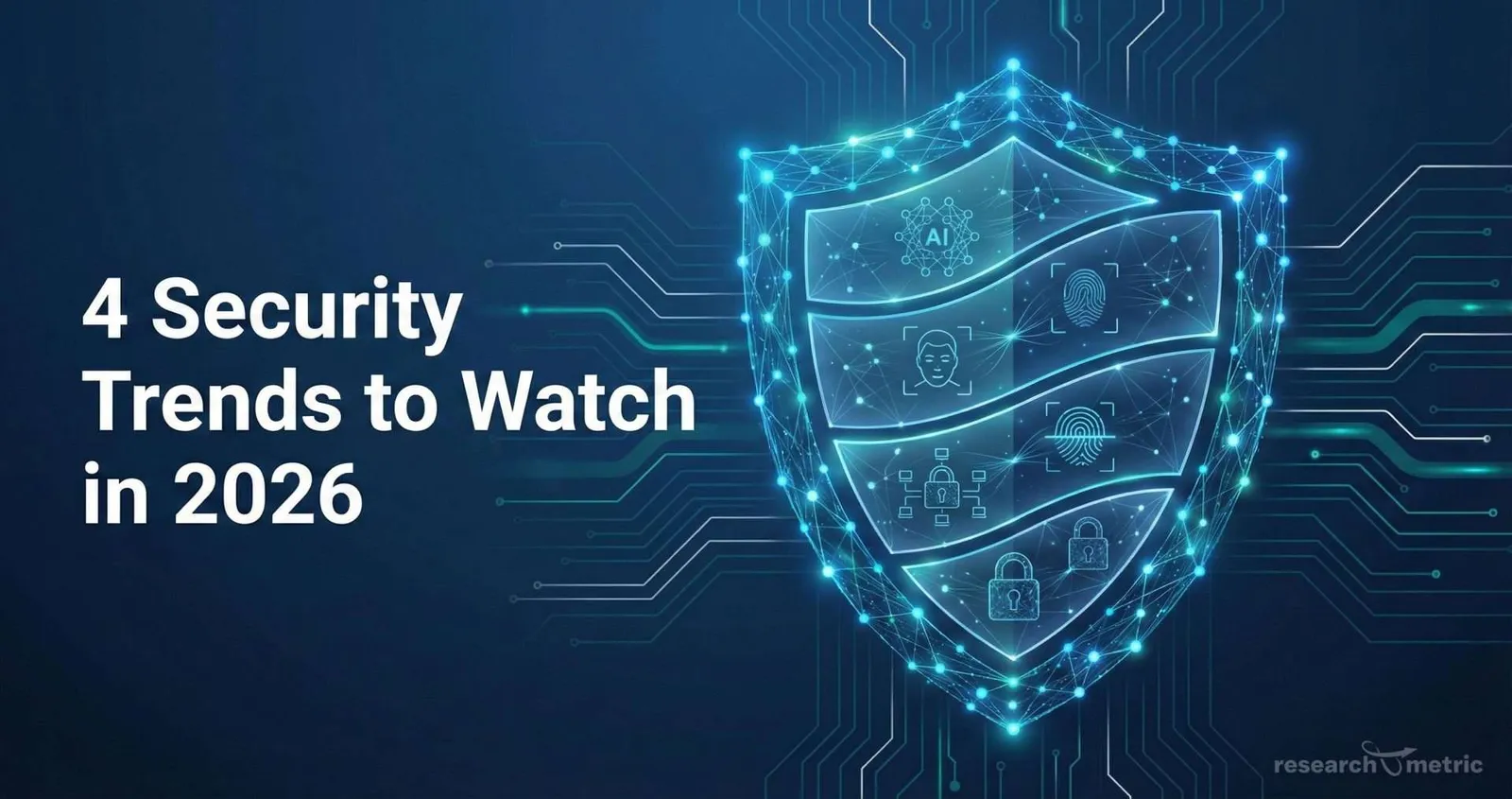
Security trends 2026 are not abstract predictions. They are active forces reshaping enterprise protection right now. These four shifts span AI-driven defence, zero trust maturation, expanding data privacy regulation and identity security as critical infrastructure. Together, they demand immediate attention and strategic action.
The organisations that thrive will treat security as a strategic enabler rather than a cost centre. They will invest proactively in the technologies, frameworks and intelligence these trends demand. By contrast, the cost of inaction is measured not only in financial terms, with cybercrime expected to cost the world $10.5 trillion annually. It also shows up in lost trust, competitive disadvantage and operational vulnerability.
Ready to understand how these trends are reshaping your industry? Contact Research and Metric today to see how our AI-powered research can turn your security market data into actionable intelligence.
FAQ: Security Trends 2026
What are the top security trends 2026 and why do they matter?
The top trends include AI-driven threat defence, zero trust adoption, expanded data privacy regulations and identity security as critical infrastructure. They matter because they represent fundamental shifts in how organisations protect digital assets and manage risk. They also affect how businesses maintain competitive advantage in an increasingly hostile cyber environment.
How do these security trends impact enterprise decision-making?
They directly influence enterprise technology investment, governance frameworks and operational strategy. For example, organisations that align their security roadmaps with AI-driven defence and zero trust architecture are better positioned. They can reduce breach risk, meet regulatory requirements and build stakeholder trust across global markets.
What are the key technological shifts shaping security in 2026?
The key shifts include autonomous AI agents for threat detection and response. They also include the move from perimeter-based to zero trust security models. In addition, privacy and security architectures are converging. Finally, identity management is expanding to cover machines, IoT devices and AI agents alongside human users.
Investment and Support Questions
What ROI can businesses expect from investing in security trends 2026?
Businesses investing in AI-driven security automation and zero trust frameworks can expect reduced breach costs and faster incident response. They can also expect improved regulatory compliance and stronger customer trust. Gartner research suggests that organisations adopting continuous exposure management will be three times less likely to experience a breach. As a result, these investments can translate directly into measurable financial returns.
How can Research and Metric help with security trends 2026?
Research and Metric provides AI-driven market intelligence on security. We help organisations benchmark security investments, understand competitive dynamics and identify emerging opportunities across the EU, UK, APAC and other global markets. Our quantitative and qualitative research methodologies deliver actionable insights that inform security strategy at executive level. Learn more about our services.
Get new articles by email
Useful tips on surveys and research. One email when we post something new. Unsubscribe anytime.